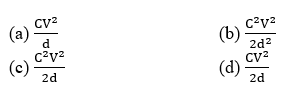
A parallel plate air capacitor has capacity C, distance of separation between plates is d and potential difference V is applied between the plates. Force of attraction between the plates of the parallel plate air capacitor is
Text Solution
Verified by ExpertsThe correct answer is:
A
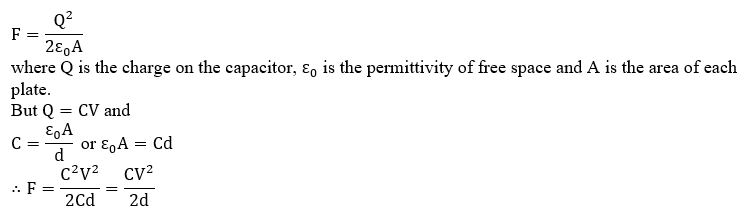
Force of attraction between the plates of the parallel plate air capacitor is
Prepare Smarter with CGP Edu
Get practice questions, solutions, and test series in one place.
Write a Review
Share your experience with this question and solution.
Commentary
Send your comment, doubt, correction, or feedback to admin.
Similar Questions
Explore conceptually related problems
The capacity of a parallel plate condenser is . When a glass plate is placed between the plates of…
A capacitor is charged by using a battery which is then disconnected. A dielectric slab is then sli…
The energy of a charged capacitor is given by the expression ( = charge on the conductor and C = i…
The capacity of a condenser is farad and its potential is . The energy released on discharging it…
The insulated spheres of radii and having charges and respectively are connected to each other.…
In a charged capacitor, the energy resides